

1
of
13
Loading...
Sensy-One S1 Pro Multi Sense mmWave Multisensor | WiFi version
Regular price
€54,95
Unit price
Pickup available at Dynamodz
Usually ready in 2-4 days
Shipping information
Shipping information
Orders placed on weekdays before 4:00 PM and in stock will be shipped the same day . In most cases, your order will be delivered the next day. More details can be found in our shipping policy .

Sensy-One S1 Pro Multi Sense mmWave Multisensor | WiFi version
Regular price
€54,95
Unit price

Regular price
€54,95
Unit price
Description
Description
Looking for the Zigbee version? Check out the Sensy-One S1 Pro Multi Sense (Zigbee version) here.
Multifunctional Presence and Air Quality Sensor for Home Assistant (Wi-Fi / ESPHome)
The Sensy-One S1 Pro Multi Sense is an open-source presence and environmental sensor, specifically developed for Home Assistant. This compact sensor combines advanced mmWave presence detection via the Hi-Link LD2450 radar module with extensive air quality measurement, ambient light and UV sensing, an RGB status light, and a built-in buzzer for alerts. The device runs on ESPHome firmware and integrates automatically into Home Assistant via BLE Improv (automatic Bluetooth pairing) or a wireless access point when Bluetooth is unavailable.
Connectivity and Protocols
The S1 Pro uses Wi-Fi and Bluetooth Low Energy (BLE) thanks to the ESP32-C3-MINI-1-N4 module. The sensor communicates via ESPHome and works seamlessly with Home Assistant without additional hubs or dongles. Thanks to automatic Bluetooth pairing, the device is immediately recognized by HA, so you don't need a separate configuration app. The sensor sends updates on presence, position, and movement every 30 milliseconds, ensuring real-time responsiveness in your automations.
Platform Compatibility
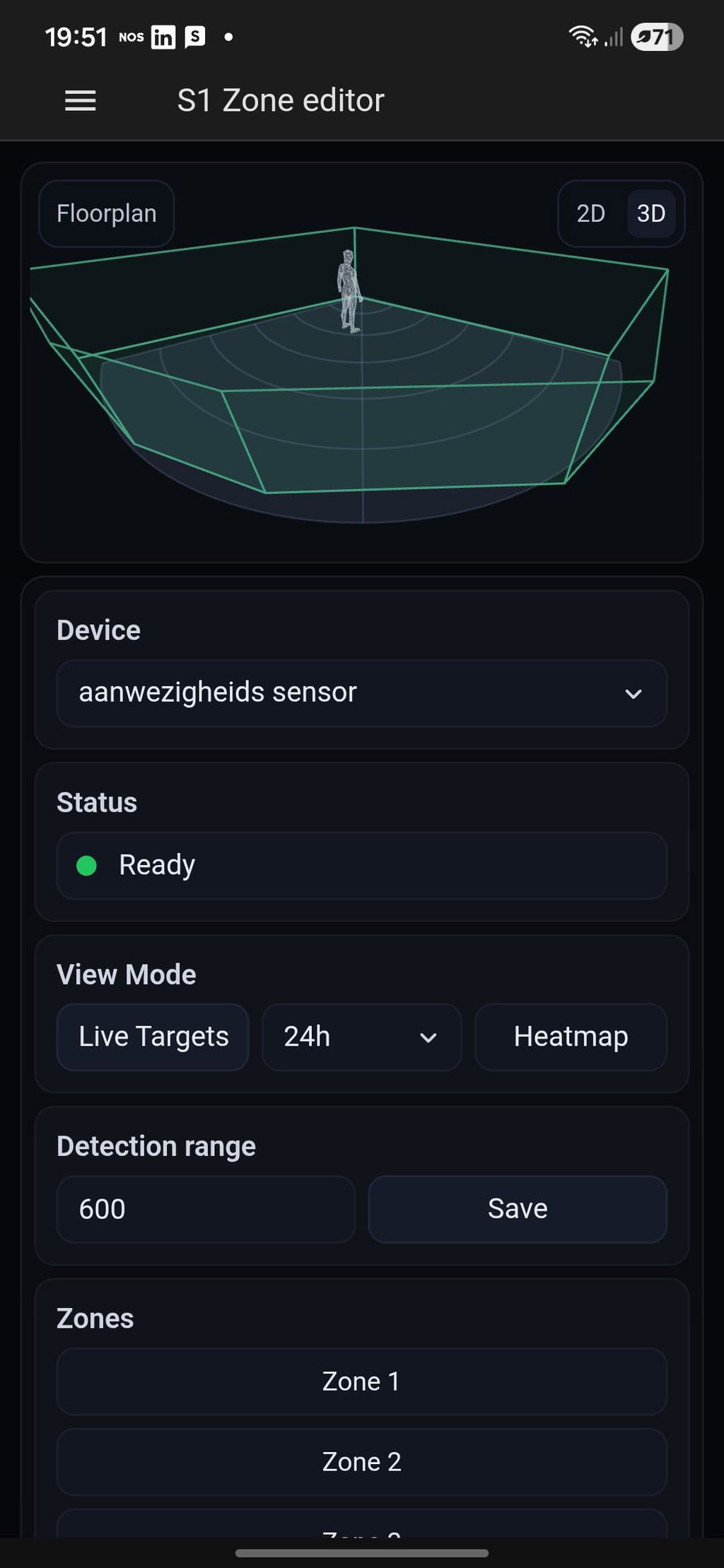
Fully optimized for Home Assistant via ESPHome. The S1 Pro is primarily intended for HA users and has its own Zone Editor integration with Heatmap functionality. Thanks to the open-source firmware, you can customize the sensor to your own needs, including adding extra add-ons, adjusting zones, and setting triggers for scenes and automations.
Power and Energy
The sensor operates on 5V USB-C and has a standard USB-C port at the bottom for mounting. Optionally, you can use the S1 Pro Female USB-C Add-on to position the sensor upright, or the S1 Pro Male USB-C Add-on to connect directly to a wall adapter without a cable. Power consumption is low thanks to the ESP32-C3.
mmWave Presence Detection
The Hi-Link LD2450 radar module offers 24 GHz mmWave detection with a range of up to 6 meters, a horizontal field of view of 120°, and a vertical range of 70°. The sensor detects up to three people simultaneously and reports their position, speed, and movement in real-time. You can set a maximum of 3 detection zones (expandable to 10 in a future update) and 1 exclusion zone to ignore movement from fans or 3D printers. Each zone has adjustable presence delay and motion thresholds, and reports the number of targets, occupancy, and motion activity per zone.
Air Quality with Bosch BME688
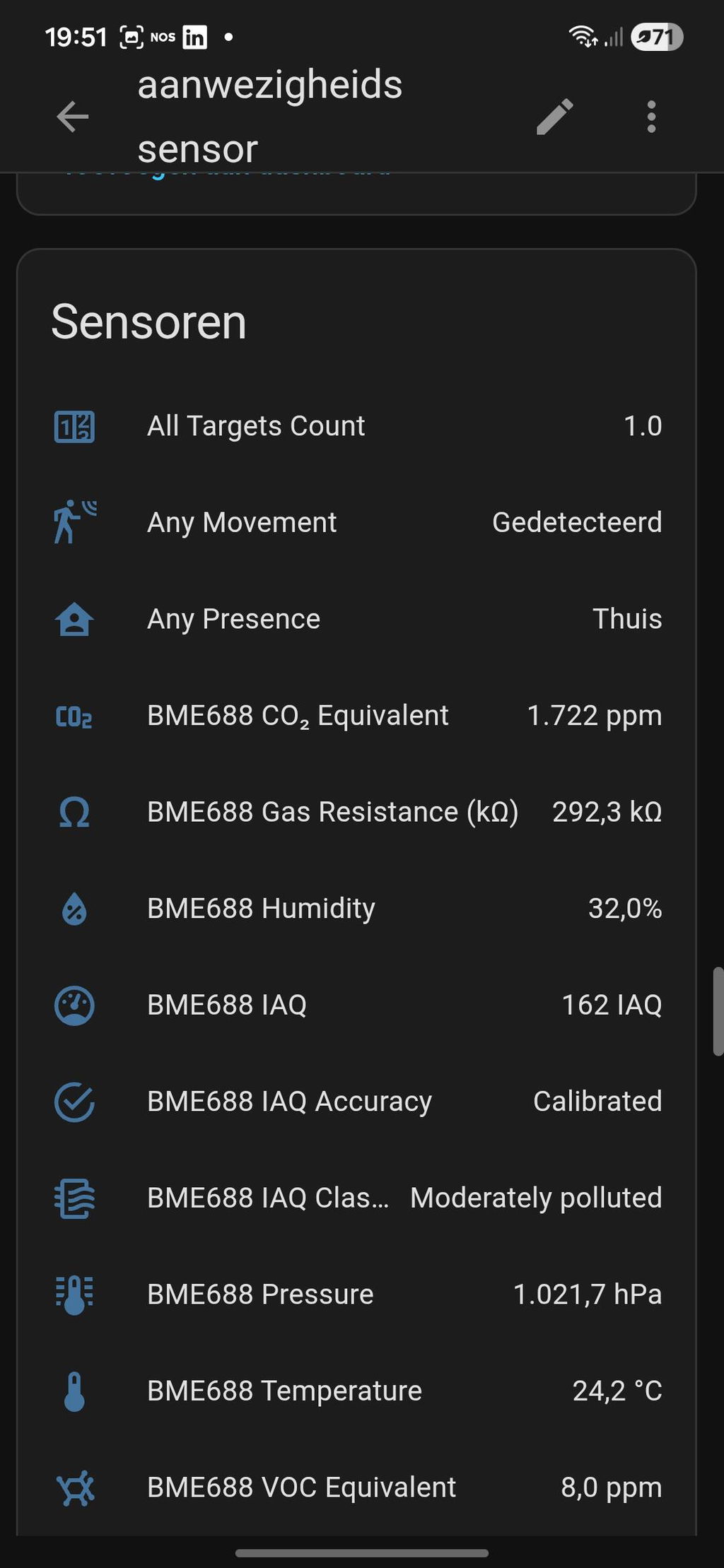
The integrated Bosch BME688 sensor is the world's first gas sensor with artificial intelligence and measures estimated CO₂ levels, gas resistance, air quality index (IAQ, a value between 0 and 500), estimated VOC levels (volatile substances), humidity, temperature, and atmospheric pressure. The BME688 detects VOCs (volatile organic compounds), sulfur compounds (an indicator of bacterial growth), and other gases like carbon monoxide and hydrogen in extremely low concentrations. The sensor uses a heated element that reacts to chemically reactive gases and creates a unique fingerprint by measuring at different temperatures. The S1 Pro uses Bosch features such as the accelerated 4-day calibration, which makes air quality measurements accurate faster after relocation. The BME688 offers ±3% accuracy for humidity, ±0.5°C for temperature (0-65°C), and ±0.6 hPa for atmospheric pressure (300-1100 hPa).
Optional CO₂ Sensor (SCD40 Add-on)
For high-quality CO₂ measurements, the S1 Pro supports an optional S1 Pro CO₂ Add-on with the Sensirion SCD40 module, which can be connected via a plug-and-play connector on the front without soldering. The SCD40 measures CO₂ with professional measurement technology and offers an accuracy of ±50-100 ppm between 400 and 2000 ppm. The module also reports temperature and humidity. The SCD40 uses altitude compensation via the BME688 pressure values, which improves CO₂ accuracy at different altitudes and weather conditions. Unlike the BME688, which estimates CO₂ via VOC measurements, the SCD40 provides true CO₂ concentrations for accurate air quality monitoring.
Automatic Sensor Compensation
The S1 Pro sensor is calibrated during production with a reference meter, ensuring accurate measurements right out of the box. If desired, the user can manually set the offset to adapt the sensor to a specific application or measurement environment. Both sensors (BME688 and optional SCD40) remain well-matched for consistent measurement results.
Ambient Light and UV Sensing
The integrated Lite-On LTR-390UV sensor measures both illuminance (Lux) and UV index (UVI). This enables smart lighting control based on natural light and provides insight into sun exposure. The sensor responds quickly and accurately, which is useful for adaptive lighting that follows daylight levels or for automatically closing blinds at high UV values.
Visual and Auditory Feedback
On the back of the PCB is a WS2812B RGB-LED that projects light onto the wall. This allows you to provide visual feedback for presence, warnings, or mood lighting via Home Assistant automations. Additionally, the sensor has a built-in Huaneng MLT-8530 buzzer that produces 80–90 dB of sound at 2.7 kHz, ideal for notifications, warnings, or presence confirmations. Both functionalities are fully configurable within ESPHome and Home Assistant.
Physical and Installation
The casing is custom-designed for minimal interference with mmWave signals and maximum airflow for accurate sensor measurements and cooling. High-quality casing with a sleek, professionally finished surface.
Dimensions: 50 mm high, 35 mm wide, 25 mm deep.
The sensor has a standard USB-C port at the bottom, a plug-and-play connector at the front for the CO₂ module (SCD40 add-on), and a plug-and-play connector at the back for USB-C add-ons (Male/Female modules).
Mounting Options (Add-ons)
The S1 Pro supports various optional mounting adapters for flexible placement. With the S1 Pro Corner Ball Mount Add-on, you can precisely position the sensor in 90-degree corners, while the S1 Pro Standard Ball Mount Add-on enables neat mounting on any wall surface. Both ball mounts offer full rotation and tilt capabilities for perfect sensor alignment. For standing mounting, use the S1 Pro Female USB-C Add-on, allowing you to place the sensor upright when the bottom is inaccessible. The S1 Pro Male USB-C Add-on enables direct connection to a wall adapter without a cable. For accurate CO₂ measurements, the S1 Pro CO₂ Add-on is available with the Sensirion SCD40 module, which connects easily via the Mezzanine connector on the front.
Software and Updates
The S1 Pro runs on ESPHome firmware, which is fully open-source and accessible via GitHub. Updates are delivered wirelessly via Home Assistant or ESPHome, without requiring physical access to the sensor. The community and manufacturer offer active support via Discord, GitHub, and YouTube, including a web-based Zone Editor for easy configuration of detection zones without programming knowledge. The firmware is regularly updated with new features and accuracy improvements. All firmware releases are documented on GitHub with detailed changelogs and installation instructions.
Environment and Durability
Intended for indoor use in standard residential and workspaces. The BME688 functions electrically between -40°C and +85°C, with full accuracy between 0°C and 65°C at 10-90% relative humidity. The SCD40 (optional) works optimally at room temperature and normal humidity. The casing is designed for maximum airflow to maintain sensor accuracy and extend component lifespan. Not suitable for humid or dusty environments such as bathrooms or workshops without additional protection. The resin casing is durable and heat-resistant. The BME688 complies with European safety standards.
Performance and Responsiveness
The mmWave sensor sends updates every 30 milliseconds, ensuring extremely responsive presence detection. The BME688 reports at intervals configurable in ESPHome, usually every few seconds to minutes depending on your preference. The BME688 has a response time of approximately 8 seconds for humidity changes and less than 1 second for gas detection in continuous mode. The SCD40 (optional) measures CO₂ values every 5 seconds by default, but this can be adjusted. The LTR-390UV responds quickly to light changes for real-time lighting control. The Wi-Fi connection via ESP32-C3 offers low latency and stable communication with Home Assistant, even with frequent updates from multiple sensors simultaneously. The accelerated 4-day calibration ensures faster adaptation to new environmental conditions.
Air Quality Index (IAQ) Classification
The BME688 with Bosch software provides an air quality index (IAQ) between 0 (pure air) and 500 (heavily polluted), with a resolution of 1. The index automatically adapts to typical environments and reports air quality in 7 categories: Excellent (0-50), Good (51-100), Lightly polluted (101-150), Moderately polluted (151-200), Heavily polluted (201-250), Severely polluted (251-350) and Extremely polluted (>351). The sensor detects VOCs from paint, new furniture, waste, cooking odors, exhaled air, sweat, and other VOC sources. The BME688 detects sulfur compounds with 95% reliability, indicating bacterial growth or decaying organic materials. The sensor has an inter-sensor deviation of ±15% IAQ after calibration and a long-term stability of ±1% IAQ drift per year under normal indoor air conditions.
Safety and Privacy
The sensor operates completely locally without a cloud connection, ensuring your privacy and security. Firmware updates are optional and entirely under your control.
Package Contents
You receive the S1 Pro Multi Sense sensor with built-in mmWave, BME688, LTR-390UV, RGB-LED, and buzzer as standard. The sensor has a USB-C port at the bottom and two plug-and-play connectors for add-ons. Five add-ons are available separately: S1 Pro CO₂ Add-on (SCD40 module), S1 Pro Female USB-C Add-on, S1 Pro Male USB-C Add-on, S1 Pro Standard Ball Mount Add-on, and S1 Pro Corner Ball Mount Add-on. A USB-C power cable is not included; you will need a standard USB-C cable and a 5V adapter.
Use Cases
The S1 Pro is ideal for Home Assistant users who want to combine reliable presence detection and air quality monitoring in one compact device. Thanks to mmWave technology, the sensor detects presence even when you are sitting still, unlike PIR sensors. Perfect for automatic switching on and off of lighting, ventilation based on CO₂ levels or air quality index, and adaptive lighting based on daylight. The BME688 warns of increased VOC levels due to cooking, cleaning products, off-gassing from new furniture, or too many people in a room. The optional SCD40 module provides accurate CO₂ measurements with altitude compensation for healthy indoor air, ideal for bedrooms, offices, and classrooms. The modular add-ons allow flexible placement, from corners to standing mounting.
Pros
- Seamless integration with Home Assistant via ESPHome and automatic Bluetooth pairing
- Advanced mmWave detection (LD2450) with multi-target tracking, positioning, and configurable zones
- Bosch BME688 AI gas sensor with air quality index, VOC, and sulfur compound detection
- Bosch software with accelerated 4-day calibration and automatic compensation for accurate measurements
- Optional high-quality CO₂ sensor (SCD40) with altitude compensation for accurate measurements
- Five modular add-ons for flexible mounting and accurate CO₂ measurements without soldering
- Fully open-source with active development, regular firmware updates, and extensive documentation
- Web-based Zone Editor for easy configuration without programming knowledge
Cons
- Limited platform support outside Home Assistant; no native integration with Google Home, Alexa, or Apple HomeKit
Manual and Support
- You can find the manual here
- Need support? The Sensy-One team is active on Discord and happy to help you!
Frequently Asked Questions
Does the S1 Pro Multi Sense work with Home Assistant?
Yes, the S1 Pro is specifically developed for Home Assistant and integrates automatically via automatic Bluetooth pairing or a wireless access point. The sensor runs on ESPHome firmware and is immediately recognized by HA without additional configuration.
How do I connect and install the S1 Pro?
Connect the sensor to a 5V USB-C power supply via the port at the bottom. During initial use, the S1 Pro automatically attempts to connect via Bluetooth to set up your Wi-Fi details. If this fails, the sensor automatically creates a wireless access point (AP) named "I am Sensy!". Connect to this network and then open your browser at 192.168.4.1 to complete the installation.
Mounting is possible via the standard USB-C port or with optional ball mounts and USB-C add-ons. For zone configuration, use the web-based Zone Editor, which requires no programming knowledge.
There is also a dedicated integration available that makes setting up zones even easier: Sensy-One Zone Editor with Heatmap functionality.
TIP: Also check the S1 Pro Github page for new updates and manuals.
What network protocol does the S1 Pro use?
The sensor uses Wi-Fi (2.4 GHz) via the ESP32-C3 module. Communication with Home Assistant occurs via ESPHome over Wi-Fi, and BLE is used for automatic pairing. Looking for a sensor that works via Zigbee? Then check out the S1 Pro Zigbee version.
Does the S1 Pro support Matter?
No, the S1 Pro does not support Matter. The sensor is fully focused on Home Assistant via ESPHome and does not offer native Matter support.
What is the range of the mmWave sensor?
The Hi-Link LD2450 radar module has a range of up to 6 meters, a horizontal field of view of 120°, and a vertical range of 70°. The sensor detects up to three people simultaneously and reports position, speed, and movement every 30 milliseconds.
What is the difference between the BME688 and the optional SCD40 CO₂ sensor?
The BME688 estimates CO₂ levels by converting VOC measurements (volatile organic compounds) via Bosch software. This is suitable for general air quality monitoring. The SCD40 (optional add-on) measures true CO₂ concentrations with professional technology and offers an accuracy of ±50-100 ppm, ideal for accurate monitoring of CO₂ levels in bedrooms, offices, and classrooms. The SCD40 uses altitude compensation via the BME688 for accurate measurements at different altitudes and weather conditions.
What add-ons are available for the S1 Pro?
There are five add-ons available: S1 Pro CO₂ Add-on with Sensirion SCD40 module for accurate CO₂ measurements with altitude compensation, S1 Pro Female USB-C Add-on for standing mounting, S1 Pro Male USB-C Add-on for direct connection to a wall adapter, S1 Pro Standard Ball Mount Add-on for mounting on any wall surface, and S1 Pro Corner Ball Mount Add-on for positioning in 90-degree corners. All add-ons are connected via plug-and-play connectors without soldering.
How do I update the firmware of the S1 Pro?
Updates are performed wirelessly via Home Assistant or ESPHome. Download the desired firmware version from the GitHub releases page and follow the instructions in the repository. After an update, it may take a few days (approximately 4 days) for the BME688 air quality readings to recalibrate. For a factory reset, you can use the official ESPHome Web Wizard via a USB-C connection to your computer.
EAN:
Payment convenience: pay the way you want
F
Bedankt voor je review! We vinden het geweldig om te horen dat je blij bent met onze Sensy-One S1 Pro multisensor. Geniet van jouw slimme oplossing!
M
Prima sensor alleen erg gevoelig voor gordijnen / fans. Je zult goed moeten nadenken of je deze sensor op de plek kan plaatsen waar je hem nodig hebt. In een kamer met gordijnen en een ventilator is dit helaas af te raden. De sensor is zo gevoelig dat dit niet gaat werken. Ik heb daarom op 1 kamer een S1 multi pro draaien van Sensy-one en op de andere kamer een Apollo MSR-2 . Ben erg tevreden met de integratie voor HA. Dat mis ik helaas met de Apollo. Zo heb je dus plussen en minnen. maar overal een prima sensor.
Hoi, bedankt voor je uitgebreide review! Fijn om te horen dat je tevreden bent, ondanks de gevoeligheid voor gordijnen en ventilatoren. Als je nog vragen of advies nodig hebt, staan we altijd klaar via de WhatsApp-knop rechtsboven op slimhuisje.nl. We helpen je graag verder!
B
Hele uitgebreide sensor die heel goed en nauwkeurig werkt. Super eenvoudig op te zetten. Aanzetten, verbinden met z'n hotspot en op de Wifi aanmelden en dan zie je 'm meteen in Home Assistant. Het product (soft- & firmware) wordt heel actief onderhouden en continu verbetererd, Met de zone editor en heatmap is het super eenvoudig om zones te definiëren en bij te werken. Ik had wat issues met de verbinding, maar dat bleek met mijn router te maken te hebben en heb ik - na supersnelle reacties in de support Discord - kunnen oplossen. Ik heb ook een Aqara FP2 Presence sensor, maar die valt in het niet bij het (Home Assistant) gebruiksgemak van de Sensy. Top!
Bedankt voor je positieve review! We zijn blij om te horen dat de Sensy-One S1 Pro Multi Sense goed werkt met Home Assistant en dat je tevreden bent met de nauwkeurigheid en gebruiksvriendelijkheid van de sensor. Sensy werkt continue aan hun producten door de software regelmatig te updaten en te verbeteren om aan de behoeften van onze klanten te voldoen. Bedankt voor het delen van je ervaring en mocht je in de toekomst nog vragen of problemen hebben, aarzel dan niet om contact op te nemen met de Sensy Discord kanaal of onze klantenservice.
t
had hem in de usb poort van de pc gestopt en esphome in home assist gestart en het besturings progje gewist
is er een mogelijkheid om de besturing er weer op te krijgen
Geen zorgen, dit is gelukkig eenvoudig op te lossen! Je kunt de originele firmware terugzetten via de officiële ESPHome Web Wizard, rechtstreeks vanuit je browser. Volg hiervoor de onderstaande stappen:
1. Download de factory firmware
Download de nieuwste factory firmware van de officiële GitHub pagina (de factory.bin
bestand):
👉 https://github.com/sensy-one/S1-Pro-Multi-Sense/releases
2. Sluit de S1 Pro aan via USB-C
Verbind de sensor met je pc via de USB-C kabel, sluit deze aan op de originele USB-C poort van de Sensy S1 Pro.
3. Open de ESPHome Web Wizard
Ga naar 👉 https://web.esphome.io in Google Chrome of Microsoft Edge (andere browsers worden niet ondersteund).
4. Installeer de firmware
Klik op Connect en selecteer de juiste COM-poort van de sensor
Klik op Install, selecteer het gedownloade firmware bestand en klik nogmaals op Install
Na de installatie verschijnt de sensor vanzelf weer als nieuw apparaat in je netwerk.
Mocht het niet lukken, laat het ons gerust weten, we helpen je graag verder!